
There is an analogy in maths teaching which asks, ‘Are you an inchworm or a grasshopper?’
‘What is an inchworm?’
Now for us Brits, the first question is actually ‘what is an inchworm?’ So just to fill that in straight away for you, they are one of those caterpillars that move forward by arching and straightening their body ‘an inch at a time.’
So what have these two insects got to do with maths?
The inchworm and grasshopper are analogies for two different approaches to mathematical thinking and problem-solving.
An inchworm tends to work through a problem step by step, following a familiar method or procedure.
A grasshopper tends to look at the bigger picture, spotting patterns, connections and alternative ways of solving a problem.
Neither approach is necessarily better than the other. Both have their strengths, and being able to switch between them is an important part of becoming a confident and flexible mathematician.
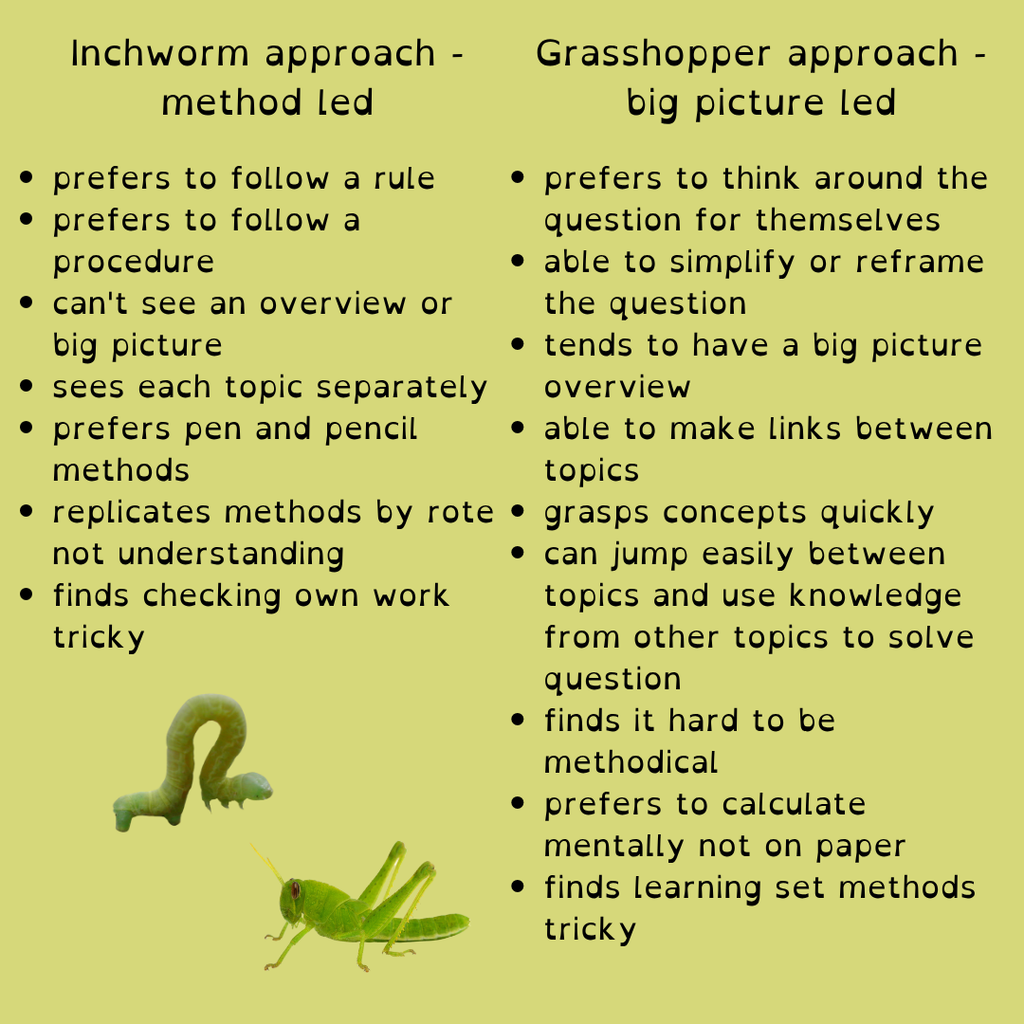
This graphic shows the way inchworms and grasshoppers think and react to learning. Which one do you think you are? What about your child?
So which insect is it best to be?
Successful mathematicians are generally those who are skilled at applying and using both approaches, as success in maths tends to require flexibility in thinking.
The most able children in a class are the ones who can adapt and switch between both styles, depending on what the task is or the numbers involved. They can be a grasshopper, jumping between concepts to notice that a question can be solved more efficiently and with less working out by linking one idea to another and then adjusting the answer. But equally, if a question is harder or more complex, they can work carefully and methodically using a set method.
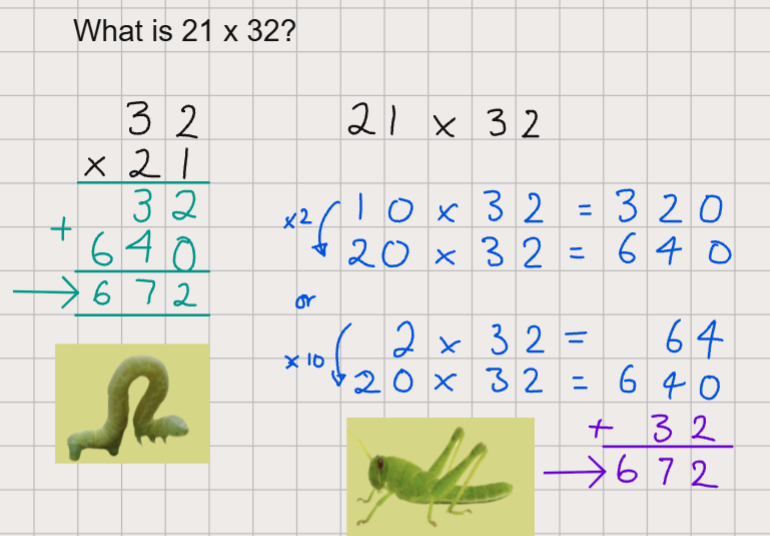
In this modelled example, the inchworm has learnt how to do long multiplication in columns, or even by another pencil-and-paper method. They see that the question is multiplication, so they use that standard method. The grasshopper, however, will look at the specific numbers given, notice how close 21 is to 20, and realise they can do this example in their head. Multiplying by 20 is the same as doubling, then multiplying by 10 (or multiplying by 10 and then doubling). They would then add on the extra 32 to make 672.
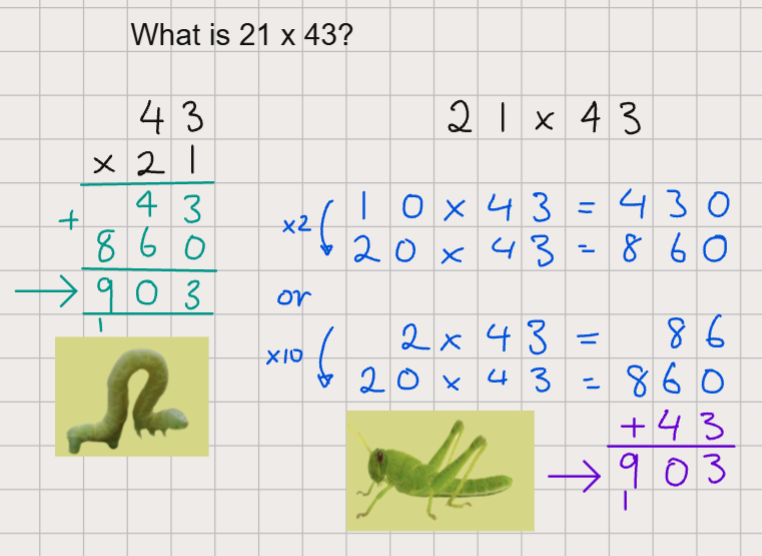
Now look at the second example; this time isn’t so clear-cut for our more able child. They could do the same: double 43 to get 86, then multiply by 10 to get 860. (Or multiply 43 by 10, then double.) But this time, when they add the extra 43, the numbers are a bit trickier as they cross the place value, and so they might then, at that point, choose to use a pencil method to add their mentally calculated 860 and 43 to make 903.
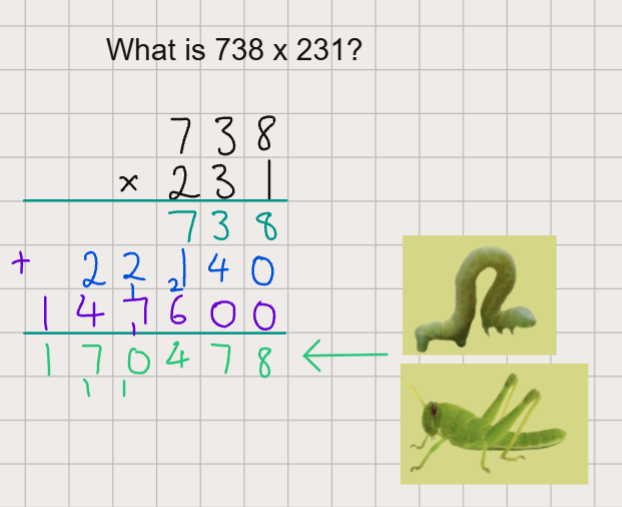
Our third example shows that the more flexible mathematician will look at the specific numbers involved this time, and because they have good number sense, they will realise that there are no easy, quick ways around this. They will need to use some type of written method to work through the long multiplication accurately.
And that last decision is itself an example of good mathematical thinking. The grasshopper isn’t abandoning their ability to see the bigger picture. They’re using it to recognise that this is the point where being methodical is the better strategy.
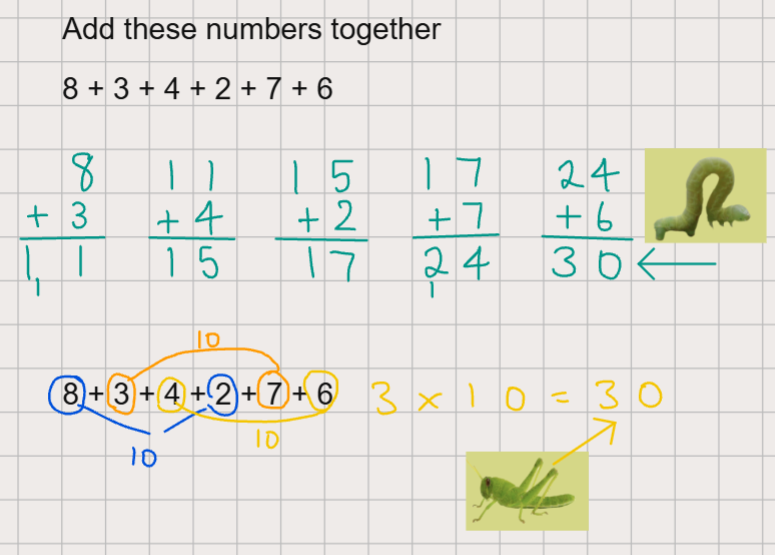
Younger children might show their learning styles by linking number bonds to 10 with the specific numbers in the question. The inchworm will work from left to right each time, adding the next number onto their total. They will have to make 5 additions and cross the tens boundary, which also requires knowledge of number bonds to 10. A grasshopper will have good number sense and can link between topics easily. For them, this question is very simple because of the specific numbers. They will notice straight away that there are three pairs of number bonds to ten: 8 + 2, 3 + 7 and 4 + 6. So quickly 3 x 10 = 30. The question wording doesn’t say “use your knowledge of number bonds to do this question”, so an inchworm will not think to do that and will follow the wording of the question, which is “Add these numbers together”. But a grasshopper WILL notice the specific numbers, make the mental leap between topics, and realise that number bonds are much easier for these numbers, as each has a number bond to pair with.
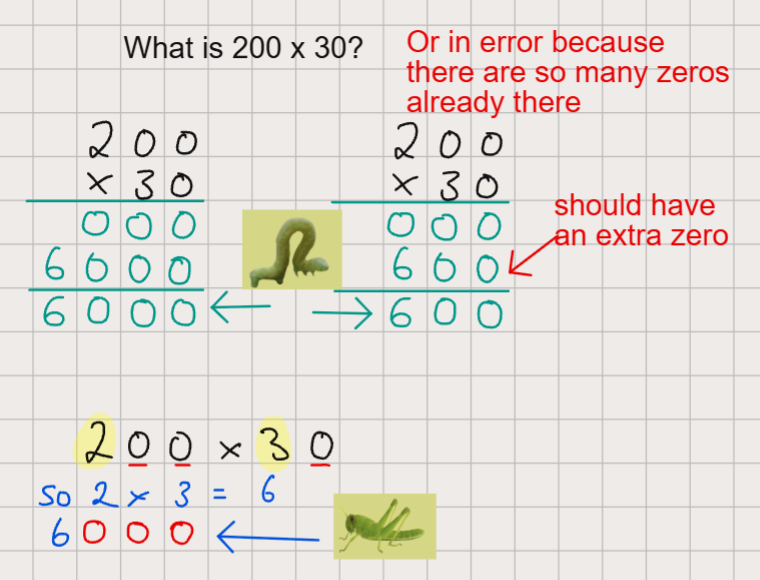
Another example is when the inchworm does the whole standard layout, including the row of zeros. But the grasshopper will spot straight away that both numbers end in zeros, use known facts, adjust the place value, and do the whole calculation in their heads. The known facts and adjust method is in fact much more robust with these numbers than using column multiplication. The chance of making a mistake with all the zeros in the column method is very high, and all but the best mathematicians in a class will probably slip up when using what is normally the most robust and reliable column multiplication method.
So why be an inchworm at all?
So you might be thinking, from these examples I have given, why would you want any children to be aiming to be an inchworm rather than this seemingly very smart grasshopper?
Looking back at the original lists, there are negatives of being a grasshopper. They find it hard to be methodical; they prefer to calculate mentally, not on paper, and find learning set methods tricky. Lacking these three strategies can be a general downfall for a child who only works like a grasshopper.
At certain stages in a child’s education, particularly in primary school, teachers may expect children to show their working using the specific method they have been taught. Sometimes, a child who has used a different but perfectly valid method can find their work marked as incorrect, even when they have reached the right answer. These children will find it almost impossible to succeed in this situation and will often come away with a low test score because they haven’t been able to conform to the standard methods expected in the syllabus or mark scheme. This is very frustrating for both child and teacher, as they are more than capable and, if given different requirements, they would probably excel. Another reason a strict grasshopper can fail is that they move too fast and then miss a crucial step or trip themselves up.
It may seem better to be a grasshopper, but sometimes grasshoppers just leap in, with no thought trail to their reasoning. They miss a crucial clue in the question or misread it and go down a blind alley. Although very instinctive, grasshoppers are less logical, and sometimes this means they will make errors in a way the inchworm will not, because the inchworm stays methodical even if it is slower. As the child gets older and prepares for GCSE, getting the correct final answer reliably every time becomes critical and far outweighs the need for speed.
So, for things we can do quickly and efficiently, it is good to be a grasshopper, but if something is really tricky, the inchworm is the best approach.
How can we encourage children to be both?
Questions like ‘Is there another way to get to the answer?’ and ‘What other topic uses …?’ can provide prompts and scaffolding, encouraging a child to think around a question rather than follow the same procedure each time.
We can also change the numbers in a question, as I did in the examples above, asking each time, ‘Let’s look at the numbers this time. Is there a quicker way to work it out?’
For children who naturally favour the grasshopper approach, we can ask, ‘How could you show somebody else how you worked that out?’
In this way, we can encourage children to develop skills in both directions: helping method-led thinkers notice alternative approaches, and helping big-picture thinkers explain and record their reasoning.
The aim isn’t to make every child an inchworm or a grasshopper. It’s to help them develop the confidence and flexibility to use both approaches, recognising when to make a leap and when to take things one step at a time.
Further reading: Being quick at maths doesn’t necessarily mean being good at maths. In my article Unlocking Maths Potential: Debunking Myths and Embracing a Growth Mindset, I explore why depth of understanding matters more than speed, and how we can help children develop confidence in their mathematical abilities.