
There are eleven main Executive Functions (EF).
Response inhibition, or inhibitory control, is the capacity to think before you act and resist the urge to say or do something.
So, what does that mean in real life, and how does it impact our ability to cope in the real world?
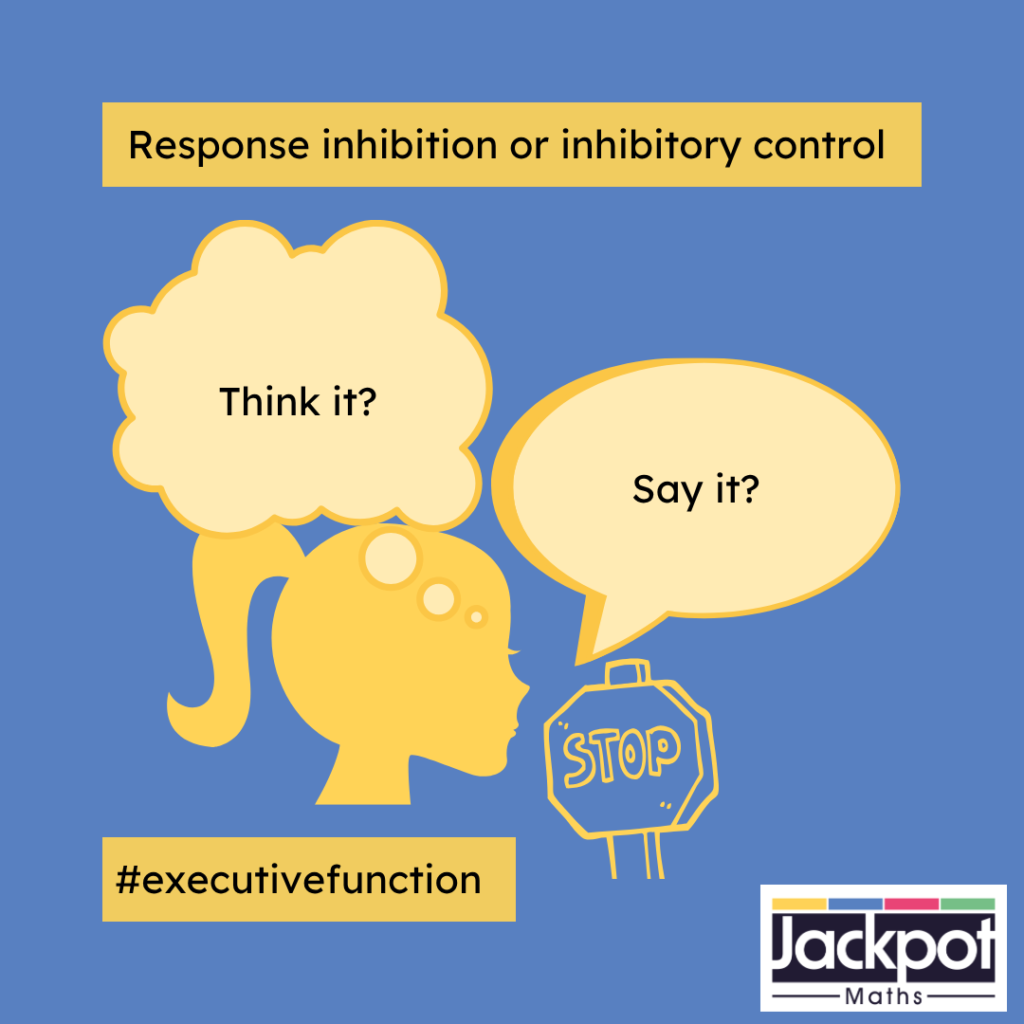
Speaking
We all know people who are blurters and just come right out and say things that most others probably might be thinking, but can make a conscious decision not to say. I am one of those blurters… I always have been, and at times it got me into plenty of hot water as a child, because I was so blunt and had no filter.
Whilst I am more able to think first and control my stream of consciousness as an adult, it does still sometimes catch me unawares. Generally, now as an adult and throughout my teaching career, I can have an element of an extra layer of self-control where my brain just knows that every word I say must be thought about extra carefully so I don’t say anything wrong to a child. Although, even now, when I am relaxed and bring down my guard when in adult company, my response inhibition does tend to drop, and I will still end up blurting something out.
Doing
The other type of inhibitory control is the urge to do things rather than just say things. Many people find this a real struggle to stay in control when excited or scared. Children or adults may get themselves into needless fights or other dangerous situations, or engage in impulsive risk-taking behaviour.
Gradually, children can get better at assessing and evaluating a situation before responding.
How it makes you feel
Do any of these inhibition responses sound familiar? Well, if you or someone you know has ADHD, they will almost certainly be struggling with these issues. You may not understand just how strong the internal difficulties are as they try to gain tighter control. Or the guilt they feel after getting themselves in bother, having just promised their mum they would stay out of trouble; this is a daily battle for some children. ADHD medications and staying away from alcohol can help.

With all the Executive Function issues, it is like we have a faulty thermostat: when we should react, we might not, and when we shouldn’t, we might… It just isn’t quite adjusted in the same way as the norm, and this is stressful to live with.
This is one of the reasons why Neurodiverse people tend to have high anxiety and are more prone to Mental Health difficulties. It is mentally exhausting to constantly try to do the right thing and fit in!
Because I live with this every day of my life, I can understand how the children who come to me for tuition feel. I can teach them in a calm and relaxed way, which will help them feel more comfortable in their own skin.
Further reading: In my article Unlocking Maths Potential: Debunking Myths and Embracing a Growth Mindset, I explore why depth of understanding matters more than speed, and how we can help children develop confidence in their mathematical abilities. Also, other blogs about Executive Functions Adapting to Change: The Role of Cognitive Flexibility in Our Neurodiverse World